








WHO-GMP Certified Pharma Company in India 2026
By Administrator 12 min read
WHO-GMP Certified Pharma Company in India 2026 | Mediquest Pharma
The Indian pharmaceutical sector in 2026 stands as an indispensable pillar of global healthcare. India manufactures and exports billions of doses of lifesaving medications, earning its reputation as the pharmacy of the world. However, as global regulatory frameworks become stricter and healthcare professionals demand higher safety metrics, identifying a reliable WHO-GMP certified pharma company in India has become a vital priority for pharmaceutical distributors, PCD franchise partners, and healthcare entrepreneurs.
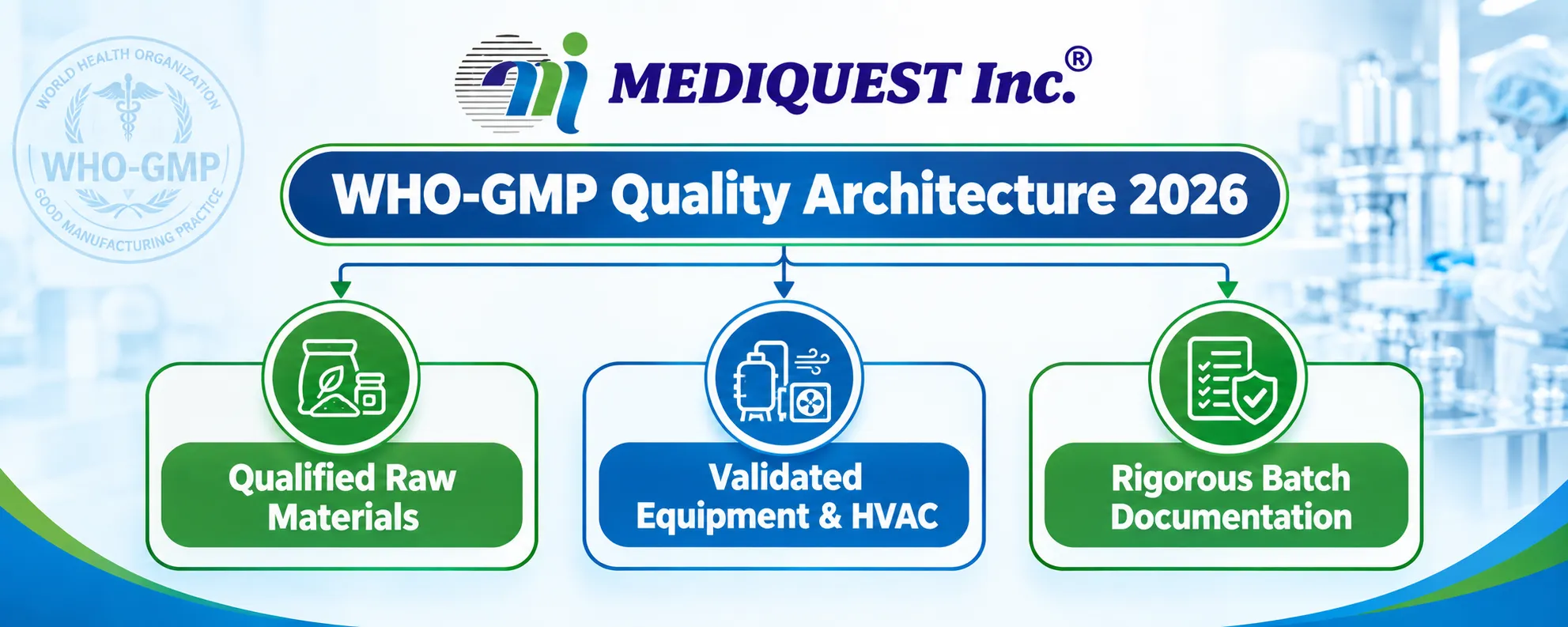
Adherence to World Health Organization Good Manufacturing Practices (WHO-GMP) ensures that pharmaceutical formulations are consistently produced and controlled according to strict quality standards. Partnering with a reputable WHO-GMP certified pharma company in India guarantees that therapeutic products fulfill their intended use and meet rigorous market authorization requirements. Reliable pharmaceutical distribution firms—including established names such as Mediquest Pharma —consistently stress that working with compliant manufacturing partners safeguards patient safety, brand integrity, and long-term business growth.
This comprehensive 2026 guide breaks down the core tenets of Good Manufacturing Practices, details how quality control and quality assurance operate in modern drug production, outlines evaluation frameworks for shortlisting manufacturing partners, and explores how working with a compliant WHO-GMP certified pharma company in India creates sustainable commercial opportunities.
The Landscape of the Indian Pharmaceutical Industry in 2026
The Indian pharmaceutical market in 2026 is defined by unprecedented technical advancement, stricter regulatory oversight, and growing global reliance on Indian formulations. Key drivers shaping the market landscape include:
- Revised Schedule M Mandates: Regulatory mandates across India have aligned domestic manufacturing rules closely with international WHO-GMP protocols, elevating baseline quality standards across small, medium, and large manufacturing units.
- Focus on Complex Formulations: Beyond standard generic oral solids, Indian manufacturers produce advanced drug delivery systems, biologicals, lyophilized injectables, and sustained-release formulations.
- Digital Traceability and Data Integrity: Modern manufacturing facilities integrate digital batch recording systems, automated environmental monitoring, and 2D barcode serialization to prevent counterfeiting and ensure full batch traceability.
- High Demand for Compliant PCD Franchises: Franchise seekers and stockists increasingly prefer partners sourced from a compliant WHO-GMP certified pharma company in India to protect their local market reputation and avoid batch recalls.
What Does WHO-GMP Mean and Why Does It Matter?
Understanding Good Manufacturing Practices requires distinguishing guidelines from statutory certification. The World Health Organization creates international quality standards, but it does not directly inspect or certify individual pharmaceutical plants.
Instead, a WHO-GMP certified pharma company in India is inspected and certified by the relevant national or state regulatory authorities—such as the Central Drugs Standard Control Organization (CDSCO) or State Licensing Authorities—who evaluate manufacturing operations against WHO-GMP guidelines and issue official GMP certificates.
Why WHO-GMP Matters
- Ensures Batch-to-Batch Consistency: Standardized SOPs guarantee that every tablet, capsule, or syrup produced delivers the exact same therapeutic strength and dissolution profile.
- Builds Prescriber and Patient Confidence: Doctors prefer prescribing products manufactured in facilities that maintain verifiable quality compliance.
- Protects Legal and Commercial Interests: Sourcing products from a verified WHO-GMP certified pharma company in India protects stockists and distributors from legal penalties associated with sub-standard or misbranded drugs.
Companies like Mediquest Pharma understand these industry dynamics and prioritize sourcing formulations from certified facilities to ensure that every product delivered to franchise partners meets stringent therapeutic standards.
Key Principles of Good Manufacturing Practices
Good Manufacturing Practices govern every operational element within a pharmaceutical manufacturing plant. A compliant WHO-GMP certified pharma company in India builds its quality culture around ten foundational principles:
- Clearly Defined Manufacturing Processes: Every manufacturing step is evaluated, validated, and documented to ensure predictable outcome consistency.
- Facility Design and Environmental Control: Cleanroom environments utilize specialized Heating, Ventilation, and Air Conditioning (HVAC) systems to maintain differential pressure, humidity, and air purity levels.
- Trained and Qualified Personnel: Staff members receive regular training in hygiene, operational procedures, safety protocols, and quality maintenance.
- Comprehensive Documentation: Detailed records prove that every process step was performed strictly according to established instructions.
- Equipment Qualification: All production and analytical instruments are routinely calibrated, cleaned, and maintained to prevent operational drift.
- Cross-Contamination Prevention: Dedicated air locks, pressure cascades, and clean-in-place (CIP) systems eliminate cross-contact between distinct drug formulations.
- Traceability and Recall Systems: Comprehensive batch records enable rapid tracing, holding, or recalling of any batch if safety concerns arise.
- Complaint Management: Standard procedures exist to log, investigate, and correct any product feedback or market defects.
- Regular Internal Audits: Self-inspection teams conduct routine internal audits to verify continuous compliance with evolving guidelines.
- Sanitation and Hygiene: Strict sanitation regimes apply to personnel, raw materials, manufacturing surfaces, and environmental areas.
By adhering to these principles, a professional WHO-GMP certified pharma company in India maintains quality across all batch sizes and therapeutic lines.
Quality Control (QC) vs. Quality Assurance (QA) in Manufacturing
While Quality Control and Quality Assurance are closely linked, they serve distinct operational functions within a pharmaceutical plant. The table below illustrates how these two disciplines collaborate within a compliant WHO-GMP certified pharma company in India:
| Operational Parameter | Quality Assurance (QA) | Quality Control (QC) |
| Primary Operational Focus | Process-oriented: Prevents defects by designing and managing overall quality systems. | Product-oriented: Detects defects by testing physical, chemical, and biological samples. |
| Timing of Execution | Active throughout the manufacturing life cycle, from facility design to distribution. | Executed at specific stages: raw material receipt, in-process steps, and finished product release. |
| Core Responsibilities | SOP creation, batch record reviews, validation protocol approval, and audit management. | Assay testing, dissolution profiling, microbial testing, stability testing, and HPLC analysis. |
| Key Output | Quality systems, compliance clearance, and released Batch Manufacturing Records (BMR). | Certificates of Analysis (COA), analytical data sheets, and lab test reports. |
| Role in Risk Management | Establishes preventative frameworks to avoid process errors and contamination. | Verifies that finished formulations meet predefined pharmacopeial specifications. |
A top-tier WHO-GMP certified pharma company in India ensures seamless coordination between QA and QC teams. This integration guarantees that formulations distributed through partners—such as Mediquest Pharma—are manufactured under controlled conditions and rigorously verified prior to market release.
Raw Material Inspection and Supplier Qualification
The efficacy of a finished drug formulation depends directly on the quality of its starting materials. A WHO-GMP certified pharma company in India enforces rigorous control over Active Pharmaceutical Ingredients (APIs), excipients, and primary packaging materials.
- Vendor Qualification: API manufacturers undergo comprehensive technical audits, document reviews, and stability evaluations before being listed as approved vendors.
- Quarantine and Inspection: All incoming raw material shipments are placed immediately in quarantine areas pending QA review and sampling.
- Analytical Verification: QC laboratories test raw material samples for identity, chemical purity, potency, moisture content, heavy metals, and microbiological safety.
- Approved Inventory Management: Only raw materials bearing a verified "APPROVED" label from the Quality Assurance department are transferred to active production areas.
Sourcing from a WHO-GMP certified pharma company in India guarantees that every active ingredient used in therapeutic formulations is backed by verifiable documentation and full chemical testing.
Manufacturing Hygiene, Sanitation, and Contamination Prevention
Contamination poses an ongoing risk to pharmaceutical safety. Modern pharmaceutical manufacturing facilities enforce strict hygiene and environmental controls to eliminate physical, chemical, and biological hazards.
- HVAC Systems and HEPA Filtration: Cleanrooms utilize High-Efficiency Particulate Air (HEPA) filters that purify intake air, removing air particles down to 0.3 microns.
- Pressure Cascades: Differential air pressures prevent airborne dust and active ingredients from migrating between processing suites.
- Personnel Gowning Protocols: Operators wear specialized sterile gowning, masks, hair covers, and shoe covers before stepping into controlled processing areas.
- Clean-In-Place (CIP) and Sterilize-In-Place (SIP): Automated cleaning systems clean production tanks and filling pipelines between batches, eliminating cross-contamination risk.
A compliant WHO-GMP certified pharma company in India maintains these environmental boundaries to ensure that tablets, capsules, injectables, and syrups remain completely pure.
Equipment Validation, Documentation, and Batch Traceability
Documentation forms the operational backbone of Good Manufacturing Practices. In the pharmaceutical industry, an unrecorded activity is legally treated as an unperformed activity. A WHO-GMP certified pharma company in India maintains detailed records for every batch produced.
- Master Formula Card (MFC): An approved document establishing the precise quantity of active ingredients, excipients, and process steps required for a formulation.
- Batch Manufacturing Record (BMR): A live document filled out by operators during manufacturing, detailing raw material lot numbers, exact processing times, equipment IDs, temperature readings, and yield checks.
- Equipment Qualification (DQ/IQ/OQ/PQ): Facilities complete Design, Installation, Operational, and Performance Qualifications for every piece of manufacturing machinery before using it in production.
- Batch Traceability: Unique batch numbers link raw material origins, manufacturing operators, environmental parameters, lab test reports, and distribution destinations.
When business owners partner with a transparent distributor like Mediquest Pharma, they gain access to products backed by complete batch records and verifiable Certificates of Analysis.
Packaging, Labelling, Storage, and Distribution Practices
The drug quality maintained during manufacturing must be protected through packaging, storage, and transport. A WHO-GMP certified pharma company in India uses advanced packaging and logistics protocols to maintain stability throughout shelf life.
Advanced Packaging Materials
High-grade packaging materials protect formulations from light, humidity, and oxygen:
- Alu-Alu Blisters: Provide maximum moisture and light protection for sensitive oral solids.
- Amber Glass Vials: Protect light-sensitive liquid formulations and injectables.
- Tamper-Evident Seals: Ensure consumers receive genuine, unmanipulated medications.
Climate-Controlled Warehousing and Cold Chain
Finished drugs are stored in temperature-controlled warehouses monitored by automated sensors. Heat-sensitive items—such as biologicals, vaccines, and certain pediatric drops—are stored and shipped using validated cold-chain systems to prevent thermal degradation during transit.
Operating alongside a WHO-GMP certified pharma company in India ensures that formulations arrive in pristine condition, ready for safe commercial distribution.
The Role of Regulatory Compliance and Inspections
Certifications are not permanent; they require continuous adherence to evolving rules and regular regulatory re-audits. State and national regulatory authorities inspect manufacturing facilities periodically to verify ongoing WHO-GMP compliance.
Inspections assess sanitation, equipment calibration, QA/QC operations, staff qualifications, analytical data integrity, and complaint handling. If deficiencies are observed, manufacturers must implement Corrective and Preventive Actions (CAPA) immediately.
Working with a compliant WHO-GMP certified pharma company in India gives stockists, franchise partners, and healthcare providers confidence that their supply source stands on solid regulatory ground.
How to Evaluate a WHO-GMP Certified Pharma Company in India
Selecting the right partner requires thorough due diligence beyond reviewing basic promotional brochures. Use this structured evaluation framework when shortlisting a WHO-GMP certified pharma company in India:
- Verify Certificate Authenticity: Request a copy of the official WHO-GMP certificate and verify its validity, scope, and license number with the issuing State Licensing Authority.
- Review Manufacturing Licenses: Ensure the plant holds valid drug manufacturing licenses (such as Form 25 or Form 28) covering the specific formulation types you need (e.g., tablets, capsules, injectables, or syrups).
- Conduct an On-Site or Third-Party Audit: Where feasible, visit the production plant or request a technical audit report to inspect cleanroom standards, lab equipment, and warehousing conditions.
- Evaluate Product Portfolio and Packaging Quality: Inspect product samples for seal integrity, foil strength, print clarity, and barcode legibility.
- Assess Batch Testing and Documentation Support: Ensure the supplier provides a batch-specific Certificate of Analysis (COA) with every dispatch.
- Examine Business Transparency and Customer Support: Confirm that pricing schedules, minimum order quantities (MOQs), delivery lead times, and damage return policies are clearly documented in writing.
Evaluating Mediquest Pharma as a Business Partner
When evaluating pharmaceutical distributors and suppliers against industry quality standards, business owners can review several verifiable operational parameters for Mediquest Pharma:
Strategic Regional Presence
Headquartered in the northern pharmaceutical hub of Chandigarh/Panchkula, Mediquest Pharma serves as a prominent distribution and marketing partner for healthcare professionals, distributors, and PCD franchise operators across India.
Diverse Formulation Portfolio
Mediquest Pharma supplies an extensive catalog of over 353 formulations spanning 20 therapeutic categories, including:
- Anti-Infectives & Antibiotics: Formulations like Cefuroxime Axetil (
EFUTIL-500) and Amoxicillin with Clavulanic Acid (MQ-CLAV 375). - Gastrointestinal & Pain Care: Advanced proton pump inhibitors, analgesics, and anti-inflammatory medicines.
- Specialized Healthcare Divisions: Dedicated lines under InMed Therapeutics (Cardiac and Diabetic care), Nutica Herbocare (Ayurvedic and herbal formulations), and pediatric lines.
Commitment to Sourcing Quality
Mediquest Pharma sources its formulations from ISO 9001:2015 and WHO-GMP compliant manufacturing facilities. This sourcing model ensures that every batch delivered to franchise partners maintains high standards for chemical purity, dissolution, and therapeutic efficacy.
Transparent Commercial Terms
Mediquest provides stockists and franchise owners with clear price structures, comprehensive product dossiers, batch testing documentation, and defined territorial franchise rights. This transparency makes Mediquest Pharma an accessible choice for expanding a regional healthcare enterprise.
Business Opportunities for PCD Franchises, Distributors, and Wholesalers
Collaborating with a WHO-GMP certified pharma company in India opens lucrative avenues for commercial expansion across multiple distribution channels:
1. PCD Pharma Franchise Expansion
PCD (Propaganda Cum Distribution) franchise owners gain regional monopoly rights to market high-demand therapeutic ranges. Sourcing products from a WHO-GMP certified pharma company in India gives franchise operators a decisive competitive edge when detailing formulations to prescribers.
2. Wholesale Supply to Retail Chemist Networks
Wholesale distributors supplying retail pharmacies and nursing homes rely on rapid inventory turnover and consistent product quality. Partnering with compliant manufacturers minimizes product complaints and builds long-term trade trust.
3. Institutional and Government Tenders
Hospital supply networks and government procurement agencies require strict proof of manufacturing compliance. Presenting WHO-GMP compliance documentation is essential for qualifying for institutional supply contracts.
Conclusion
In the evolving pharmaceutical landscape of 2026, selecting a partner backed by a WHO-GMP certified pharma company in India is a fundamental decision for distributors, franchise owners, and healthcare entrepreneurs. Adherence to WHO-GMP standards guarantees that medications are produced in clean environments, backed by rigorous QA/QC protocols, documented through detailed batch records, and packaged to preserve therapeutic potency.
Organizations such as Mediquest Pharma illustrate how sourcing from WHO-GMP compliant plants—combined with a broad portfolio of 353+ formulations across 20 therapeutic categories—enables regional business partners to grow sustainably while maintaining uncompromised quality. By conducting thorough verification, inspecting batch documentation, and choosing compliant partners, pharmaceutical businesses can protect patient health and achieve long-term commercial success.
Partner with Mediquest Pharma: Ready to grow your business with a quality-driven, reliable pharmaceutical supplier? Explore Mediquest Pharma’s portfolio of 353+ formulations across 20 specialty divisions. Contact Mediquest Pharma today to request a complete product catalog, review commercial terms, and secure PCD franchise distribution rights in your territory.
Frequently asked questions
Q1. What is a WHO-GMP certified pharma company in India?
A WHO-GMP certified pharma company in India is a pharmaceutical manufacturer whose facilities have been inspected and certified by national or state licensing authorities (such as CDSCO) as compliant with the World Health Organization's Good Manufacturing Practice guidelines.
Q2. Does the World Health Organization directly issue GMP certificates to pharma companies?
No. The World Health Organization establishes international GMP guidelines, but official WHO-GMP compliance certificates are issued by relevant national or state drug regulatory authorities after inspecting the manufacturing facility.
Q3. Why is WHO-GMP compliance critical for PCD pharma franchise partners?
WHO-GMP compliance guarantees that products delivered to franchise partners are pure, safe, consistently manufactured, and correctly labeled. Sourcing from a WHO-GMP certified pharma company in India protects franchise owners from batch recalls, quality complaints, and regulatory liabilities.
Q4. How does Mediquest Pharma ensure product quality for its partners?
Mediquest Pharma sources its 353+ formulations from ISO 9001:2015 and WHO-GMP compliant manufacturing facilities. Every batch undergoes rigorous quality testing and is accompanied by a Certificate of Analysis (COA) to ensure high therapeutic standards.
Q5. What key documents prove that a pharma batch is compliant?
Core compliance documentation includes the Batch Manufacturing Record (BMR), Batch Packaging Record (BPR), Certificate of Analysis (COA) from the QC lab, and raw material qualification sheets.
Tags:WHO-GMP Certified Pharma Company in IndiaGood Manufacturing Practices PharmaQuality Control Pharmaceutical ManufacturingMediquest Pharma Quality StandardsPharmaceutical Compliance CDSCOPharma Manufacturing Standards 2026Mediquest PharmaWholesale Pharma Distributor India
Interested in a PCD pharma franchise?
Talk to our team for franchise terms and the complete product list.

